





The Feast of Saint Michael
We love to celebrate Feast Days in our home – especially our name days. Our patron Saints are some of our dearest heavenly friends. Yesterday was the Feast of Saint Michael the Archangel. I really wanted this day to be special for Mike. Growing up, I knew the importance of asking for Saint Michael’s help, yet my relationship with him really grew the moment I met Mike. Since then – I’ve been calling upon the intercession of Saint Michael each day – for thirteen years!
Earlier this week I took time to research some traditions in celebrating this great day, to implement as much as we could into our celebration. I discovered that Saint Michael’s Feast used to be a Holy Day of Obligation until the 18th century. I pray that someday it returns as one. We made sure to attend Mass and our son Peter was able to altar serve. I wore white to Mass, in honor of the Archangels!


The Prayers
Prayer truly is at the heart of celebrating Feasts and Mike and I started our morning with the Liturgy of the Hours and Morning Prayer. I also found an Invocation of Angels prayer, as well as prayers to Saint Michael, Saint Raphael, and Saint Gabriel that we prayed in this book.

Michaelmas Daisies
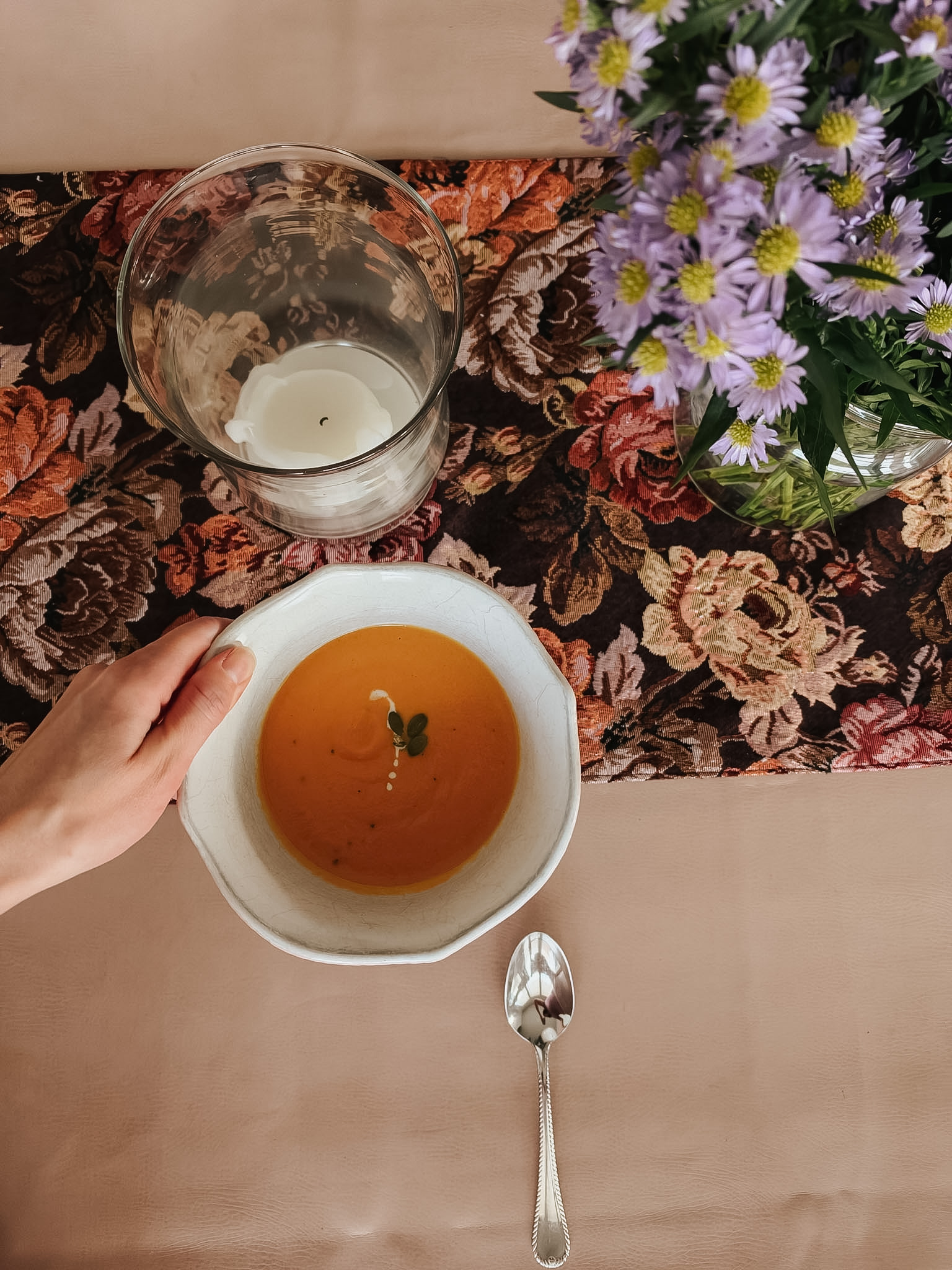
When I was researching I read that there is a flower called the Michaelmas Daisy – a purple aster. I immediately called different nurseries around Dallas to see if any of them had purple asters in stock. None did! Before I went into the grocery store to gather supplies for our meal, I asked God to surprise and delight me with some Michaelmas Daisies. As I turned to the floral section, I saw them! I ran over and confirmed with the florist that they were indeed, purple asters. I thanked God for His love and I need to dry and save at least one stem to remember how He is a God who surprises and delights!

The Feast
Food is such an integral part of how our family celebrates, and we loved discovering all the traditional fares associated with this day. Here are some things I learned in my exploration:
- In Ireland and throughout the British Isles, this day has three symbols: “glofe, gees, and gyngeuer” (gloves, geese, and ginger). “The glove represented the open-handedness and generosity of the lord of the village, eating goose brought good luck in the coming year, and ginger provided protection against infection.”
- An old English proverb claims: “If you eat goose on Michaelmas Day you will never lack money all year.” This seems to have originated with the practice of presenting a goose to the landlord when paying the rent. According to a sixteenth-century poet: And when the tenants come to pay their quarter’s rent, They bring some fowl at Midsummer, a dish of fish in Lent, At Christmas a capon, at Michaelmas a goose And somewhat else at New-year’s tide, for fear their lease fly loose.
- In Scotland, the Sunday before Michaelmas was known as Carrot Sunday. Women would dig carrots using a three-pronged mattock (symbolizing St. Michael’s trident) to dig triangular holes (symbolizing Michael’s shield).
- According to legend, when St. Michael thrust the Devil out of Heaven, Satan landed on a blackberry bush and then in revenge he spat on the plant, making it unfit to eat. Because of this, many do not eat blackberries after this Feast day. So today is the day to eat them!
To incorporate these traditions, we made the following:
- An Autumn Harvest Salad for lunch, honoring the change of season that Michaelmas brings. We swapped the fig preserves for a lovely blackberry preserve and it was delicious!
- For dinner, I made one of my favorite soup recipes, Carrot Ginger Soup. How perfect is that – combining the “gyngeuer” and the Carrot Sunday customs!
- Instead of goose – which was unavailable at every store I called and went to (truly a wild goose chase!) we had duck breast. I did get to tell the poulterer about Michaelmas though, so that was a win!
- We ended the day’s Feast with blackberries over whipped cream – delicious!


What Liturgical Living Looks Like
Liturgical Living does not have to be extravagant or expensive. It can if you want it to be. But remember Christ loves simplicity. I’ve noticed in my own life you can put a Catholic twist on almost anything. So use what you already have within your own homes. Yet no matter what we do it should have the end goal of drawing us closer to Christ. Liturgical Living is the way we enter into holy seasons and holy days and live out our faith: always with the Mass – the highest form of Liturgy at the forefront. So as we talk about Liturgical Living in our lives we must remember that Mass on Sundays and Holy Days of Obligation is the most important. Everything else, how we celebrate these Feasts in our homes, flows from that and is secondary.
Pope Saint John Paul II prayed that, “May each Christian family really become a little church in which the mystery of the Church of Christ is mirrored and given new life.” What we do within our domestic church, our home, is important. Our senses help us understand the realities of our faith. What we touch, taste, see, smell, and hear shapes how we believe, think, and act. These Liturgical Living practices – no matter how seemingly small deeply impact our lives.
Liturgical Living looks like:
- Attending Mass each Sunday and Holy Days of Obligation. To make our homes into a “little church” we must be attending the “big Church.” When able, try to attend special Feast Days, and Daily Mass!
- Participating regularly in the Sacrament of Confession
- Teaching and learning about our Catholic faith
- Doing our best to follow the rhythm of the Liturgical Calendar: observing the Fasts, Feasts, Penances, and Obligations that the Church clearly outlines for us
- Prayer and Devotions
- Food we eat
- Discipline and sacrifice through abstinence and fasting
- Practicing traditions of our Church and Church history
- Singing, Crafts, and Activities
- What we wear
- How we decorate: holy images, statues, Liturgical colors
- And countless other ways! There are so many creative ways to live liturgically.
This week is such a beautiful one – filled with wonderful Feasts: yes, Michaelmas – yet also Saint Jerome, Saint Thérèse of Lisieux, our Guardian Angels, and Saint Francis of Assisi! So many opportunities to live out our faith.

Listen to the latest
Tune into the Finding Philothea Podcast where my husband, Mike, and I share the mercy, beauty, and joy of a life lived for Christ.
Podcast